01 · Carrier
Anumá Airship
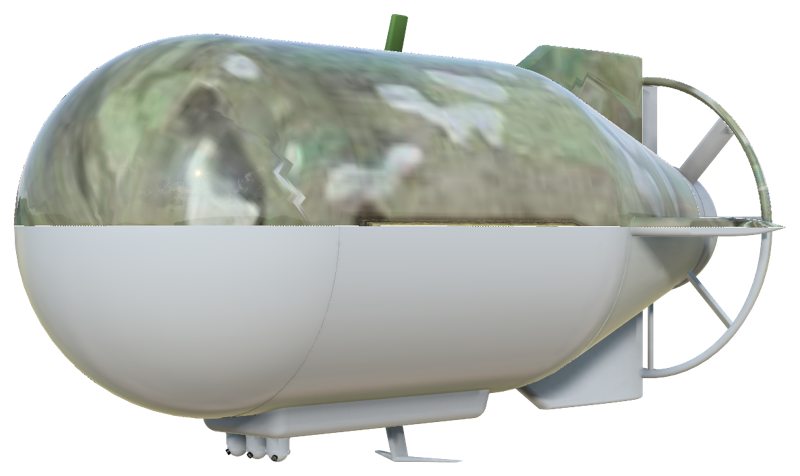
The Anumá Airship is a partial-vacuum lift (PVL) carrier platform that flies sensor payloads over contaminated ground — gas-free, US-patented lift technology with no helium or hydrogen to resupply. It's designed to remain aloft for up to 730 days without landing.
- Carries the 3rd-party sensor technology payload across large survey areas, hours to days on station.
- Powered by solar and battery, with in-field recharging possible at any farm or village along the route.
- Operates over open agricultural and rural terrain without requiring the ground infrastructure a vehicle-based survey would.
Proven, not conceptual
The lift mechanism is already built and flight-tested — a geodesic carbon-fiber frame that rises by pumping air out and descends by letting air back in. It's currently at TRL 4–5 on the standard 1–9 Technology Readiness Level scale, used across the EU and US Department of Defense: validated in a lab environment and in a relevant, real-world-like environment. Watch the mechanism explained →